Chemical Spills and Leaks
Chemical spills and leaks can be broken down into two basic types: simple spills, which you can clean up yourself, and complicated spills, which require outside assistance.
If your spill meets ANY of the following conditions, it is a COMPLICATED SPILL.
A person is injured; or
The identity of the chemical is unknown; or
Multiple chemicals are involved; or
The chemical is highly toxic, flammable or reactive; or
The spill/leak occurs in a "public space" such as corridors; or
The spill/leak has the potential to spread to other parts of the building such as through the ventilation system; or
The clean up procedures are not known or appropriate materials are not readily available; or
The clean up requires a respirator (including cartridge respirators) to be worn and no personnel have been trained and fit-tested in accordance to the campus Respiratory Protection Program; or
The spill/leak may endanger the environment by reaching waterways or outside ground, or by going down a drain
If none of the above conditions are met, the spill is defined as a simple spill. You may clean up simple spills in accordance with Chapter 6 of the Chemical Safety Guide. For consultative assistance, call Division of Research Safety (DRS) at 333-2755.
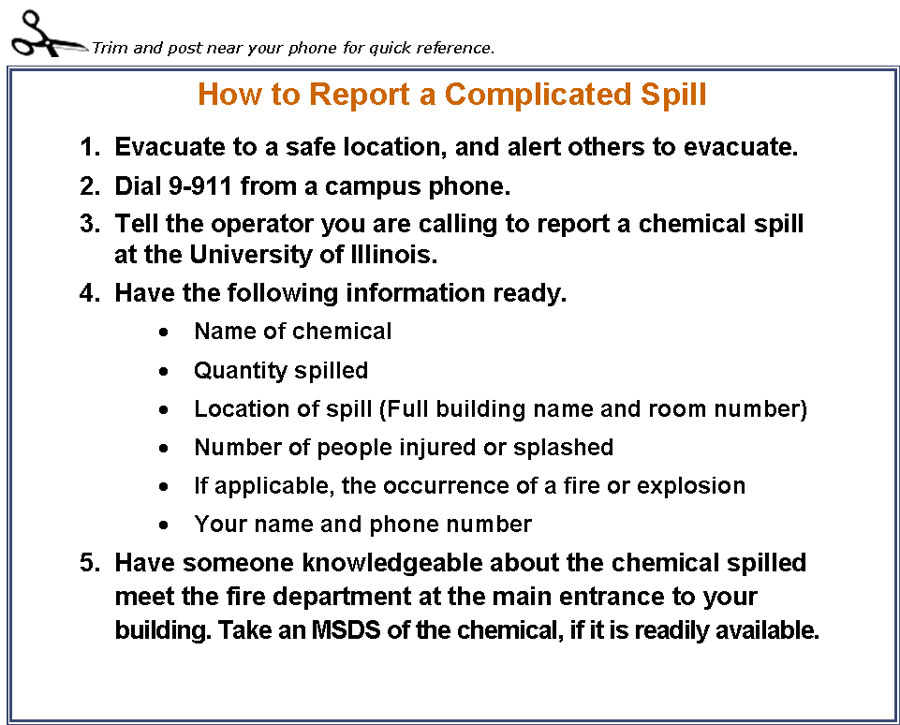
What should be done when a Complicated Spill occurs?
Evacuate the area, alerting others in the area to follow.
If possible, confine the spill area by closing doors and windows.
From a safe location, call 911 immediately.
Secure the area so no one will enter until the emergency responders arrive.
Send someone with knowledge of the chemical spilled to meet the fire department at your building's main entrance. If a Material Safety Data Sheet (MSDS) is readily available, the contact should take a copy to provide to the responders.
When reporting a Complicated Spill, what information should be relayed?
What is the name of the chemical spilled?
What quantity of the chemical is spilled?
Where is the spill? (Give building name and location in the building, i.e. room, hallway, etc.)
Has anyone been injured or splashed with the chemical? If so, how many people?
Is a fire or explosion involved in the spill?
What is your name and phone number?
What will need to be done after the responders leave?
Emergency responders will only stabilize the spill. They will not complete the clean-up. It will need to be packaged in accordance with Chapter 8 of the Chemical Waste Management Guide. A request for pick-up must be submitted to DRS. In most cases you will be able to do this yourself; in other cases an outside party may be required. If personnel from DRS are not present to advise you during the emergency response, call 333-2755. After hours, request DRS assistance through the Division of Public Safety by calling 333-1216.
Simple Spills
If the spill does not meet any of the conditions for a complicated spill, the spill is defined as simple. You may clean up simple spills as described below.
Follow These Steps to Respond to a SIMPLE Chemical Spill
If possible, close doors and windows to prevent the spread of fumes and vapors.
Turn off all potential sources of ignition (Bunsen burners, pumps, mechanical equipment not designed to be spark-proof, etc) if the spilled material is flammable (it may be necessary to turn off power from a remote circuit breaker).
Put on gloves, lab coat, apron, eye protection, and other PPE, as necessary.
Absorb liquids using appropriate absorbent material (such as spill pads, spill pillows or loose sorbents)
- Do not attempt to neutralize acids or bases - absorb each liquid spill as is.
- Do not use silica products to clean up hydrofluoric acid.
- Do not use combustible materials to clean up oxidizers. For instance, do not use paper towels for nitric acid spills.
Carefully sweep powder spills to avoid contaminating the air with chemical dust.
Collect and contain clean-up materials in a plastic container or thick plastic bag and affix descriptive labels
Decontaminate the affected area and equipment (soap and water can be used to clean most surfaces) and ventilate the area, if necessary.
Follow the Procedures for Requesting Chemical Waste Disposal in Chapter Chemical Waste Management Guide. If you have questions, contact the DRS Chemical Safety Section via e-mail or call 333-2755.