Potentially Explosive Experiments
Some chemical compounds can be highly energetic/explosive and therefore present significant hazards. Some classes of compounds are sensitive and can be initiated to decompose into a violent release of energy and gas with the slightest input of energy (heat, light, friction, or shock). Ask questions to determine if your experiment is potentially explosive and, if so, how to minimize the risk.
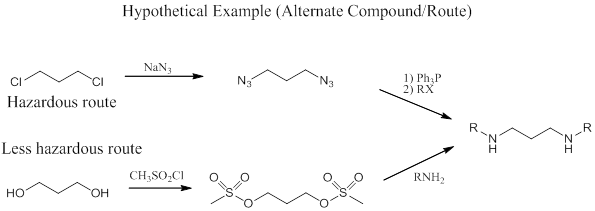
Is there an alternate compound/route?
There are many routes to the same destination as the hypothetical example below shows. Have you considered an alternate compound/route to avoid a potentially dangerous situation?
Dangerous bonds present?
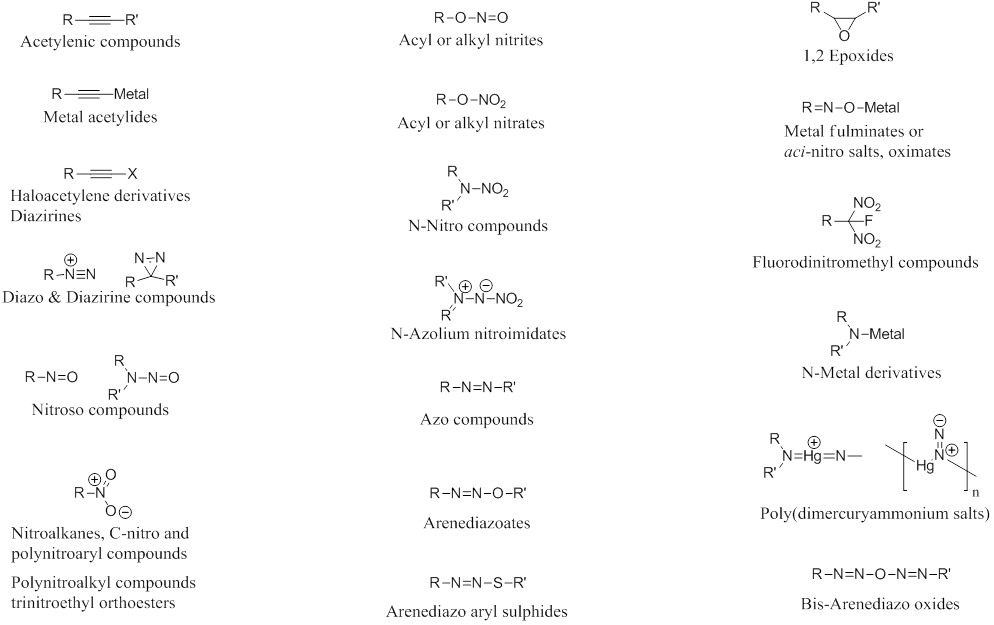
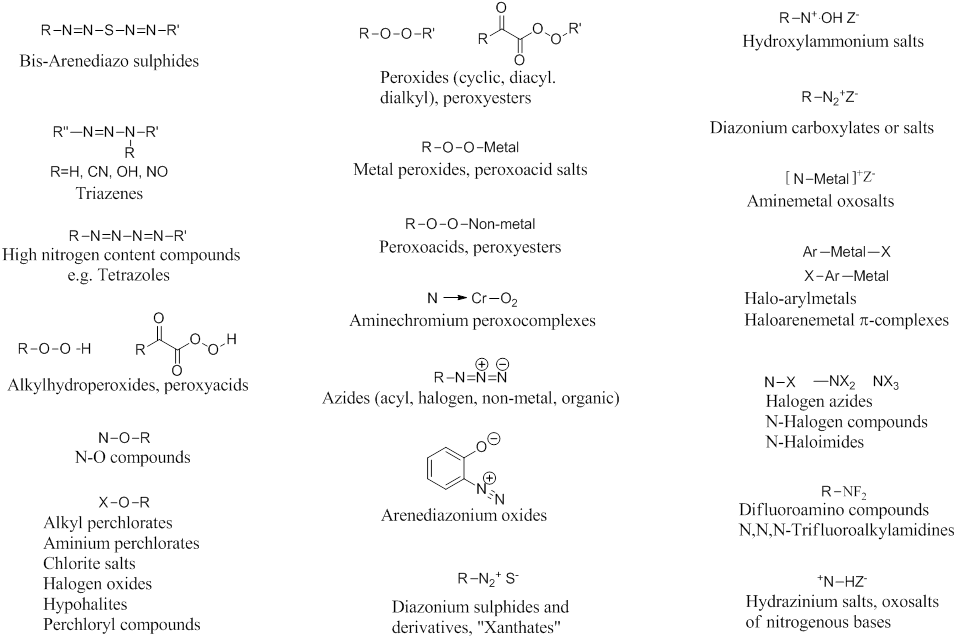
Certain chemical bonds can be inherently energetic and/or unstable. See list below to identify if your compound has potential issues.
Does your compound obey the "Rule of Six"?
The "rule of six" dictates that 6 carbon atoms (or other atoms of similar size) per energetic functional group (see list above—acetylenic, azide, epoxide, diazo, nitro, peroxide, etc.) should provide enough dilution to render the compound potentially safe. WARNING: Do not be lulled into a false sense of security if your compound does not have nitrogens. Acetone peroxide has no nitrogens and is very energetic.
Was this experiment performed previously?
If possible, talk to researchers who are experienced (previously ran this experiment) before proceeding with experiment. Ask what measures/precautions they took. Try to glean any information from them that they might have forgotten to record. If the experiment was not previously conducted, perform a thorough hazard assessment before performing experiment.
Was a reaction hazard assessment performed?
Utilize and perform the steps in the Reaction Risk Assessment Form to identify any potential hazards and how to deal with them.
What scale was experiment performed on?
If you are attempting to perform work on a potentially explosive compound, be sure to perform it on small scale (< 1 gram) to verify its safety before scaling up the experiment. The general rule of thumb is that scale-up reactions should not exceed a 5-fold increase per experiment. Would you rather work with a firecracker in the chemical fume hood or a full stick of dynamite? Be aware of the scale!
Are you using a shield?
Whether it be a face shield, blast shield or the hood sash, if you are performing a potentially explosive experiment you need to use some kind of shield to protect yourself from flying chards of glass, metal, chemicals, heat and gas. If properly chosen, a shield should provide you a sufficient level of protection without hindering your ability to manipulate the experiment.
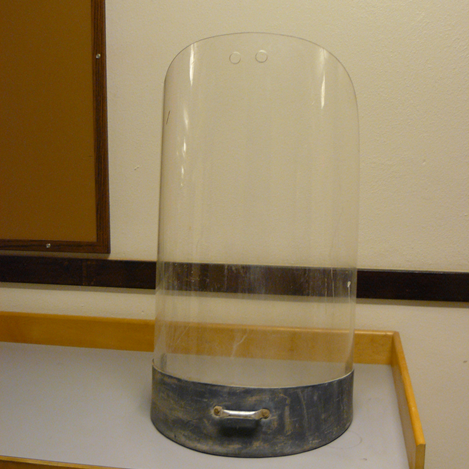
Blast shield.
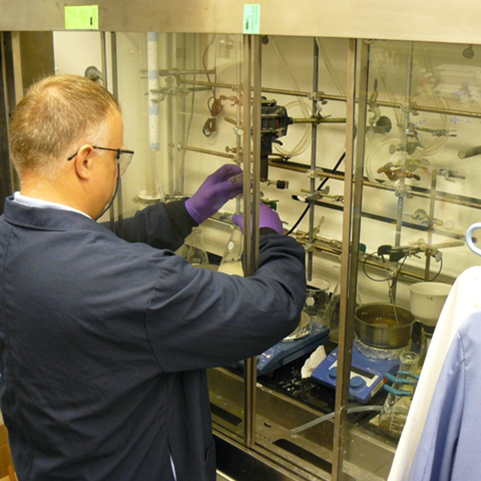
Notice researcher using hood sashes as a shield.
How are you performing the reaction, quench, workup and purification?
Many explosive compounds are sensitive to heat which can make processes (refluxing, sublimations, distillations) very dangerous. Be careful of rotovaping solutions at temperatures that are too high. Use low boiling point solvents or vacuum distillations, if possible, to avoid higher temperatures and avoid using halogenated solvents with azides and alkali metals (Potassium, Sodium, Lithium, etc.). In addition rotovaping down large amounts of peroxide forming solvents needs to be done carefully due to concentrating peroxide levels. Check peroxide levels with peroxide test strips.
Many explosions happen because reactions are not being fully quenched (e.g. epoxidations) when finished. Be sure to fully quench your reaction before proceeding to do your workup. Make sure all interior surfaces (even glassware joints) get exposed to the quenching reagent for an appropriate amount of time. Shock and friction sensitive compounds pose other problems. Procedures utilizing vigorous stirring and sonication should be reconsidered. Crystallizations and extractions of these compounds can be performed with slight modifications to equipment (e.g. avoid sintered funnels) or procedures (e.g. avoid vigorous extractions).
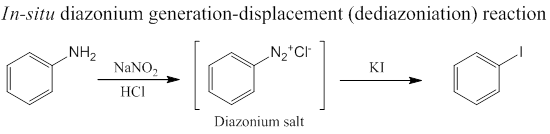
Procedures utilizing in-situ techniques (generation, displacements, etc.) allow for skipping potentially hazardous steps. For example, in the synthesis of diazonium compounds, their isolation is avoided and are generated and displaced in-situ. Diazonium salts can be very dangerous when crystalized.
Procedures such as diazomethane distillations can be very challenging due to explosive sensitivity to bright light, sharp/rough edges and scratched glassware. It is also highly toxic. Specialized diazomethane distillation equipment (flame polished joints) is commercially and readily available. Trimethylsilyldiazomethane(CAS 18107-18-1) is a convenient and safer substitute for the use of diazomethane.
Just in case...What emergency equipment and procedures do you have in place?
In the event that something goes wrong, do you have good emergency procedures in place? Who else is in the lab with you? Where are the eyewash stations, fire extinguishers, emergency showers? Where are the fire alarms? Who do you call? Where do you go? How will you get there? Do you have MSDS to show emergency responders? Knowing this beforehand can save precious seconds and your life!
References
P.G. Urben (Ed.), Bretherick's Handbook of Reactive Chemical Hazards 6th Ed., Oxford, Butterworth-Heinemann, 1999.
J.P. Agrawal; R.D. Hodgson, Organic Chemistry of Explosives, West Sussex, John Wiley & Sons, 2007.
T. L. Davis, The Chemistry of Powder & Explosives, Hollywood CA, Angriff press, 1943.
Kolb, H.C.; Finn, H.C.; Sharpless, B., Angew. Chem. Int. Ed., 2001, 40, 2004-2012.
B.S. Furniss; A.J. Hannaford; P.W.G. Smith; A.R. Tatchell. Vogel's Textbook of Practical Organic Chemistry 5th Ed., Singapore, Longman Group UK Limited, 1989.
Prudent Practices in the Laboratory, The National Academies Press, 2011.