Chemical Hazard Classification (GHS)
Legal Requirements
The Hazard Communication Standard (29CFR 1910.1200) requires all manufacturers or distributors of any products containing chemicals to evaluate the chemical hazards of the product. The evaluation is performed by classifying each chemical based on published toxicological or other data to determine its physical and health hazards.
The identified hazards have to be communicated on the container label and in documents called Safety Data Sheets (SDS). Manufacturers and distributors are required to provide safety data sheets to their clients that describe the results of the classification and all known hazards of a chemical.
Globally Harmonized System (GHS)
The Globally Harmonized System (GHS) was developed by the United Nations for international standardization of hazard classification and communication. OSHA has adopted GHS, and beginning June 2015, all manufacturers are required to prepare labels and SDS according to GHS. Some manufacturers already comply with this regulation.
GHS Label Elements
The main health and physical hazards have to be indicated on the product label by using pictograms, signal words, and standardized hazard statements. The pictograms are explained in the next paragraph. The signal word "Danger" is used for severe hazards and "Warning" is used for less severe hazards. Based on the classification of the product, the hazards are described in standardized phrases called "hazard statements". For example, a highly toxic chemical requires a statement "Fatal if inhaled or swallowed".
GHS Hazard Classes
The GHS classification further divides health and physical hazards into separate classes such as toxicity, irritation, sensitization, flammability, etc. The severity of the hazard within each class is described by the category. Some classes have five categories; other classes have only one category. Category 1 or A always represents the highest hazard within that class. The higher the category number, the lower the hazard. The classes, their categories and pictograms are as follows:
Health Hazards
| Pictogram | Hazard Class | Category | Description |
|---|---|---|---|
Corrosion
| Skin corrosion | Category 1A, 1B, 1C | Irreversible skin damage |
| Serious eye damage | Category 1 | Irreversible eye damage | |
Skull and Crossbones
| Acute toxicity, oral | Category 1, 2, 3 | Highly toxic in small amounts, serious health effects or death |
| Acute toxicity, dermal | Category 1, 2, 3 | ||
| Acute toxicity, inhalation | Category 1, 2, 3 | ||
Health Hazard
| Aspiration Hazard | Category 1, 2 | May be fatal if aspirated |
| Sensitization, respiratory | Category 1, 1A, 1B | Induces hypersensitivity of the airways | |
| Germ cell mutagenicity | Category 1A, 1B, 2 | May cause genetic defects | |
| Carcinogenicity | Category 1A, 1B, 2 | May cause cancer | |
| Reproductive Toxicity | Category 1A, 1B, 2 | May damage fertility; may damage the unborn child | |
| Specific target organ toxicity, single exposure | Category 1, 2 | Causes damage to organs | |
| Specific target organ toxicity, repeated exposure | Category 1, 2 | Causes damage to organs through prolonged or repeated exposure | |
Exclamation Mark
| Eye irritation | Category 2A | Causes serious eye irritation |
| Skin irritation | Category 2 | Causes skin irritation | |
| Acute Toxicity, oral | Category 4 | Harmful if swallowed | |
| Sensitization, skin | Category 1 | May cause an allergic skin reaction | |
| Acute toxicity, dermal | Category 4 | Harmful in contact with skin | |
| Specific target organ toxicity, single exposure, Respiratory tract irritation | Category 3 | May cause respiratory irritation | |
| Specific target organ toxicity, single exposure, Narcotic effects | Category 3 | May cause drowsiness or dizziness | |
| Hazardous to the ozone layer | Category 1 | Harms public health and the environment | |
Environment
| Hazardous to the aquatic environment, acute hazard | Category 1 | Environmental hazard |
| Hazardous to the aquatic environment, long-term hazard | Category 1, 2 |


Physical Hazards
| Pictogram | Hazard Class | Category | Description |
|---|---|---|---|
Flame
| Flammable liquids | Category 1, 2, 3 | Flammable liquids and vapors |
| Flammable solids | Category 1, 2 | Readily combustible solids | |
| Aerosols | Category 1, 2 | Pressurized container; may burst if heated | |
| Desensitized explosives | Category 1, 2, 3, 4 | Fire, blast, or projection hazard if the desensitizing agent is reduced | |
| Flammable gases | Category 1, Pyrophoric gas | Flammable compressed gas | |
| Flammable aerosols | Category 1, 2 | Flammable pressurized container | |
| Self-reactive substances and mixtures; and Organic peroxides | Type A, B, C, D, E, F, G | Thermally unstable liquid or solid that can undergo strongly exothermic reactions even without oxygen | |
| Pyrophoric liquids; Pyrophoric solids | Category 1 | Substance that can spontaneously ignite in air | |
| Self-heating substances and mixtures | Category 1, 2 | Materials other than pyrophoric materials that can react with air and without energy added. These will only ignite in large quantities or after long periods of time. | |
| Substances and Mixtures which, in contact with water, emit flammable gases | Category 1, 2, 3 | Substances that emit flammable gases when in contact with water | |
Explosive
| Explosives | Unstable Explosive, Div 1.1, 1.2, 1.3, 1.4, 1.5 | Explosive compounds and projection hazards |
| Self-reactive substances and mixtures; and Organic peroxides | Type A, B | ||
Corrosion
| Corrosive to Metals | Category 1 | May be corrosive to metals |
Flame Over Circle
| Oxidizing liquids; Oxidizing solids | Category 1, 2, 3 | Oxidizers. Are not combustible themselves, but may cause or intensify fires in other materials |
| Oxidizing gases | Category 1 | ||
Gas Cylinder
| Gases under pressure | Compressed gas, Liquefied gas, Dissolved gas | Gases under pressure, may explode if heated |
| Refrigerated liquefied gas | May cause cryogenic burns or injury |


Summary Pictograms
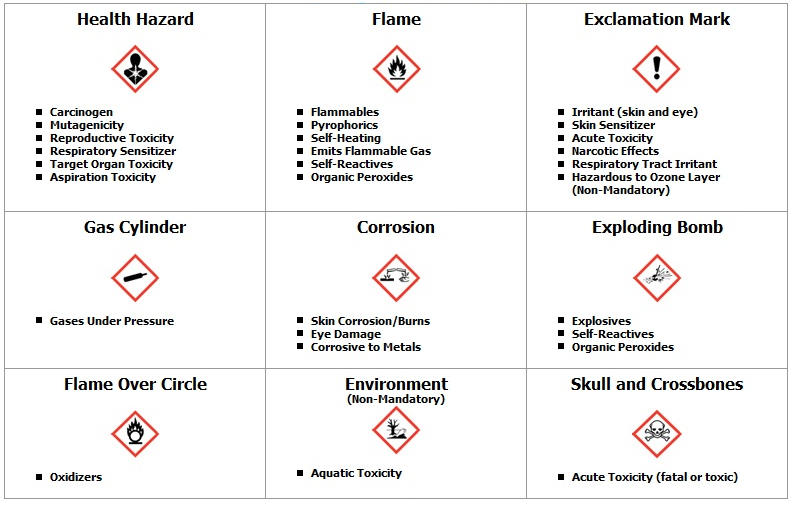
The image below shows the pictograms used for labeling. Underneath each pictogram is a list with classes the pictogram is used for.
Safety Data Sheets
Safety Data Sheets (SDS), formerly called Material Safety Data Sheets (MSDS), communicate the hazards associated with using chemicals. They are an important source of information for workers, lab personnel, emergency responders, and emergency medical personnel. As they often provide very limited information on safe handling procedures, they should be used in conjunction with safety guides provided by DRS and other knowledgeable sources (Prudent Practices, eEROS, textbooks, etc.) and standard operating procedures written for your group.
Managing SDS in a Laboratory
SDS can be available as electronic version or as hardcopies. A computer with internet connection is particularly useful to quickly access the latest SDS. Webpages like Sigma-Aldrich or Fisher Scientific are convenient and reliable sources for finding SDS. If no internet access is available, SDS of the most hazardous, largest volume, and most frequently used materials should either be stored on a computer accessible to everybody working in the lab, or as hardcopies in a binder.
Besides electronic access it is highly recommended to have hardcopies of highly toxic and corrosive chemicals available in the laboratory so they can be taken to the hospital if an exposure occurs.
Content of a Safety Data Sheet
In compliance with the new Hazard Communication Standard, SDS are divided into 16 sections and are required to provide the following information:
Identification: Product identifier used on the label; manufacturer or distributor name, address, phone number, emergency phone number; recommended use; and restrictions on use.
Hazard Identification: This section lists the GHS classification and hazard statements. Every hazard statement has a corresponding precautionary statement recommending measures to minimize or prevent adverse effects such as “Do not breathe dust.” This section may also show the label pictograms and give any other information related to known hazards of the product. Classifications by other entities such as OSHA, HMIS, or NFPA may also be given.
Composition/Information on Ingredients provides a list of all hazardous ingredients, their CAS numbers, and their concentrations or concentration ranges in the product. For each ingredient, the hazard classification is given. Depending on the concentration, the classification for each individual compound may be different than the classification of the mixture found under section 2.
First-Aid Measures describes potential symptoms and acute or delayed effects resulting from exposure. It gives information on how to respond to exposure and on appropriate medical treatment.
Fire-Fighting Measures lists suitable extinguishing techniques and equipment as well as potential hazards arising from a fire, such as toxic fumes.
Accidental Release Measures lists emergency procedures for responding to a spill, required protective equipment, and basic methods of containment and cleanup.
Handling and Storage lists brief precautions for safe handling and storage. It should contain information about incompatibilities with other chemicals, but it is often not exhaustive. Refer to the DRS chemical storage guide for more detailed information.
Exposure Controls/Personal Protection lists OSHA's Permissible Exposure Limits (PELs) and Threshold Limit Values (TLVs) for each ingredient. This section should also give information on personal protective equipment (PPE); e.g., appropriate respirators and gloves, and engineering controls.
Physical and Chemical Properties lists the characteristics of the product such as color, boiling point, pH, and density etc.
Stability and Reactivity lists chemical stability, possibility of hazardous reactions, conditions to avoid, incompatible materials, and hazardous decomposition products.
Toxicological Information describes possible routes of exposure; symptoms related to physical, chemical and toxicological characteristics; acute and chronic effects; and numerical measures of toxicity such as LD50 values if available.
Ecological information includes available information on ecotoxicity, degradability, bioaccumulation, and other adverse effects on the environment.
Disposal considerations is relevant for professional waste disposal services. Refer to the DRS chemical waste guide for disposal practices.
Transport information lists DOT UN number, proper shipping name, and class.
Regulatory information includes other applicable local regulations on safety, health, and environment.
Other information includes the date of preparation of the SDS or its last revision.