Elemental Mercury
Mercury Handling & Disposal Guidelines
Elemental (metallic) mercury and all of its compounds are toxic. Exposure to excessive levels can permanently damage the brain and kidneys, or cause a fatality.1
Organic compounds of mercury such as methyl mercury are considered the most toxic forms of the element. Exposures to very small amounts of these compounds can result in devastating neurological damage and death.1
Inhalation of elemental mercury vapor is the most common route of exposure. When mercury is spilled or allowed to come in contact with air, it evaporates. Heated mercury evaporates at a much faster rate, resulting in significantly greater risk of exposure.2
Ingestion of inorganic mercury compounds can cause severe renal and gastrointestinal damage.1
Absorption of elemental mercury through the skin can cause allergic reactions. Direct contact with the skin can lead to dermatitis.1
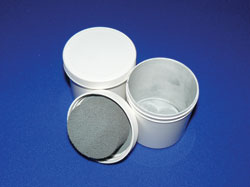
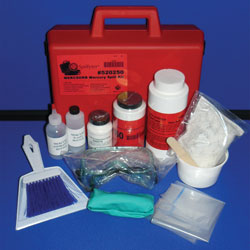
Mercury-absorbing sponges (top) and complete clean-up kits (above) are available for order through suppliers, such as Fisher Safety or Lab Safety Supply.
Prudent Practices When Working with Mercury
First and foremost, find an alternative!
- Replace mercury thermometers with alcohol thermometers
- Use oil bubblers instead of mercury bubblers
If mercury must be used, have appropriate clean-up materials available in your lab's spill clean-up kit (mercury absorbing powder and sponges)
Glass or plastic vessels containing mercury should have secondary steel or plastic container around them in case of failure
Do not use mercury where it could contact a hot surface
Avoid inhaling mercury vapor
Use appropriate gloves (consult the glove selection chart from your glove manufacturer)
Spills
The best method of dealing with mercury spills is to prevent them in the first place. Examine all uses of mercury to see if substitutes are available. If not, use trays or other equipment to provide containment in the event of a spill.
If mercury is spilled, follow these guidelines:
Cordon off the area to prevent mercury from being tracked
For small spills:
- Use mercury-absorbing sponges for cleaning up very small amounts of mercury, such as those from a broken thermometer. After cleaning up the mercury, place the used sponge and the broken thermometer (with heavy tape over the broken ends) in a sturdy plastic bag. Close and label the bag "Waste—broken mercury thermometer." Request a chemical waste pickup.
- Use mercury-absorbing powder for small spills of mercury. The powder creates an amalgam that does not emit mercury vapor. Close and label the bag “Waste-mercury debris.” Request a chemical waste pickup.
- Do not use a regular vacuum cleaner or Shop-Vac® to clean up mercury spills. Doing so will produce toxic mercury vapor in the immediate area and contaminate the vacuum cleaner.
- Do not use nitric acid to clean up spills. Mercury and nitric acid will react, creating toxic NOx gases, and a mercury nitrate waste.
For large spills, follow department/building procedures to arrange mercury clean-up service with F&S.
Disposal
All waste containing mercury is regulated as hazardous waste. There are many mercury-free alternative devices and compounds now available. The Division of Research Safety (DRS) encourages the use of mercury-free alternative devices and compounds wherever possible.
The following guidelines provide for the most efficient management of mercury wastes.
Elemental Mercury
Spilled mercury should be cleaned up in accordance with the instructions above. Elemental mercury can be collected for recycling by DRS. Please observe the following guidelines when packaging elemental mercury for recycling:
Place in a polyethylene container with a screw-on cap
Maximum weight per container is 20 pounds (approximately 670 ml)
Containers must be in good condition (no cracks, holes, leaks)
No thermometers
No amalgams
No alloys, reagents, or compounds
Broken Thermometers
In the event of a broken mercury thermometer, collect the broken glass in impermeable, sealed plastic containers. Wide mouth polyethylene jars with screw-on caps work well. If you cannot find a plastic jar large enough for your thermometer, place heavy tape over the broken ends, then overbag the thermometer in a heavy duty plastic bag. Close and label the bag "Waste—broken mercury thermometer." Request a chemical waste pickup.
1 http://orf.od.nih.gov/Environmental+Protection/Mercury+Free/MercuryHealthHazards.htm
2 http://www.idph.state.il.us/envhealth/factsheets/mercuryhlthprof.htm