Flammable Liquid Storage Cabinets
Definitions
Flammable Liquids
Those liquids having a flash point below 100°F and a vapor pressure not to exceed 40 psi at 100°F. Flammable liquids are subdivided as follows:
Class IA
- Liquids with flash points below 22.8°C (73°F) and boiling points below 37.8°C (100°F)
Class IB
- Liquids with flash points below 22.8°C (73°F) and boiling points at or above 37.8°C (100°F)
Class IC
- Liquids with flash points at or above 22.8°C (73°F) and below 37.8° (100°F)
Combustible Liquids
Those liquids having a flash point above 100°F. Combustible liquids are subdivided as follows:
Class II
- Liquids with flash points at or above 37.8°C (100°F) and below 60°C (140°F)
Class IIIA
- Liquids with flash points at or above 60°C (140°F) and below 93.3°C (200°F)
Class IIIB
- Liquids with flash points above 93.3°C (200°F)
Need for a Flammable Storage Cabinet
The need for a Flammable Storage Cabinet is driven by the class of flammable or combustible liquid present as well as the total quantity and location of these liquids. The total amount of flammable and combustible liquids allowed shall be in accordance with the amount shown in the Tables 1 and 2.
Departments can request an exemption to exceed the total quantities of flammable and combustible liquids outlined in the tables in order to meet research needs.
Table 1: Maximum Quantities of Flammable and Combustible Liquids in Non-Sprinklered Labs
| Class | Maximum Quantity per 100 sq. ft. | Maximum Quantity per Laboratory | Maximum Quantity per 100 sq. ft. | Maximum Quantity per Laboratory |
|---|---|---|---|---|
| Without Flammable Cabinet | With Flammable Cabinet | |||
| I* | 7.5L (2 gal) | 284 L (75 gal) | 15 L (4 gal) | 570 L (150 gal) |
| I*, II and III | 15 L (4 gal) | 380 L (100 gal) | 30 L (8 gal) | 760 L (200 gal) |
Table 2: Maximum Quantities of Flammable and Combustible Liquids in Sprinklered Labs
| Class | Maximum Quantity per 100 sq. ft. | Maximum Quantity per Laboratory | Maximum Quantity per 100 sq. ft. | Maximum Quantity per Laboratory |
|---|---|---|---|---|
| Without Flammable Cabinet | With Flammable Cabinet | |||
| I* | 7.5L (2 gal) | 570 L (150 gal) | 15 L (4 gal) | 1136 L (300 gal) |
| I*, II and III | 15 L (4 gal) | 757 L (200 gal) | 30 L (8 gal) | 1515 L (400 gal) |
*This category includes Class I flammable liquids and liquefied flammable gases.
Venting Flammable Storage Cabinets
Venting of flammable storage cabinets is not recommended due to the fact that it could reduce the fire protection effectiveness of the cabinet. It is recognized that some individuals and departments may want to vent these cabinets to reduce odorous vapors emanating from the cabinet. This is particularly true when the cabinet is located in an occupied area. To minimize the affect on fire resistance of the cabinet, the following criteria should be followed:
Mechanical exhaust ventilation shall be utilized. Exhaust shall be discharged above the roof using an existing lab exhaust system or as an independent system.
The cabinet shall be vented from the bottom with fresh air being supplied from the top. The flame arrestor shall remain in both the lower and upper bung holes. The bung holes should be regularly inspected and cleaned to prevent them from becoming blocked.
The exhaust duct provided shall be a material of equivalent strength (or better) as the material used for the cabinet's construction (a minimum of 18 gauge sheet steel). The exhaust duct shall also be a material compatible with the liquids stored inside the cabinet.
The exhaust duct shall be welded. The use of stove pipe, dryer vent and PVC is prohibited.
Other Considerations Concerning Flammable Storage Cabinets
Never locate the Flammable Storage Cabinet by an exit door.
Flammable Storage Cabinets must be listed by Factory Mutual, Underwriter's Laboratory or other qualified testing agency.
Materials stored inside of the Flammable Storage Cabinet should be compatible with the cabinet's design and construction.
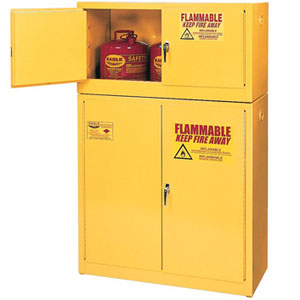
Flammable Storage Cabinets must be clearly labeled with a sign which reads: “Flammable—Keep Fire Away”
Acids should generally not be stored in a Flammable Storage Cabinet due to the corrosion of the cabinet and incompatibility with organic solvents.
Please contact Ryan Wild with Campus Code Compliance & Fire Safety at 265-5268 or rwild@illinois.edu with questions concerning the use and/or limitations of flammable storage cabinets.
References
National Fire Protection Association (1996), NFPA 30: Flammable and Combustible Liquid Code. Batterymarch, PA: NFPA
National Fire Protection Association (1996), NFPA 45: Fire Protection for Laboratories Using Chemicals. Batterymarch, PA: NFPA
Occupational Safety and Health Administration (1996). General Industry Safety and Health Standards 29CFR 1910.106. Washington, DC: Bureau of National Affairs, Inc.