Laboratory Limits
Laboratory Limits on Hazardous Compressed Gas Use
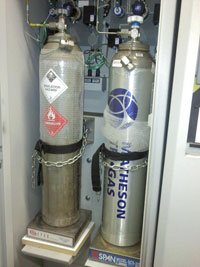
The use of hazardous compressed gases may be necessary for some research laboratory operations. The National Fire Protection Association's NFPA 45-Standard on Fire Protection for Laboratories Using Chemicals sets limits on the use and storage of hazardous gases.
This fact sheet provides practical guidance to researchers on maximum allowable quantities, appropriate storage, and special ventilation considerations when contemplating the use of hazardous compressed gases.
Maximum Allowable Quantities (MAQ)
The amount of hazardous compressed gases permissible within a Laboratory Work Area is outlined in the table below. A Laboratory Work Area is defined by NFPA 45 as "a room or space for testing, analysis, research, instruction, or similar activities that involve the use of chemicals."
| Table 1: Maximum Allowable Quantities for Hazardous Gases | |||
|---|---|---|---|
| Flammable Gas Compressed (e.g. Hydrogen, Methane) | Oxidizing Gas Compressed (e.g. Oxygen) | Toxic Gas Compressed (e.g. Carbon Monoxide) | |
| Amount Allowed per 500 ft2 of Laboratory Work Area | 6 cu ft internal cylinder volume | 6 cu ft internal cylinder volume | 0.3 cu ft internal cylinder volume |
| Maximum Number of standard cylinders | 4 cylinders (9"x51" cylinder) | 4 cylinders (9"x51" cylinder) | 1 lecture bottle |
| Lecture Bottle Limits | In addition to the maximum internal volumes above, the total number of lecture bottle cylinders shall be limited to 25 per Laboratory Work Area. | ||
Storage of Hazardous Gases
Cylinders not in use must not be stored in a laboratory. A backup cylinder is allowed only when it is properly manifolded to an in-use tank and the total allowable number of cylinders (MAQ) for the laboratory unit or work area is not exceeded.
Required Separation of Incompatible Gases
Oxidizers (e.g., oxygen) must be separated from all other flammable/reactive gases by 20ft, or by a 5ft tall two-hour rated firewall, or by 5ft if one of the gases is in a continuously mechanically ventilated enclosure
Cylinder storage must be in an appropriate facility or just-in-time delivery should be used


Special Ventilation Requirements for Gas Cylinders
Lecture bottles of the following gases located in laboratory units must be kept in a continuously mechanically ventilated hood or other continuously mechanically ventilated enclosure:
Gases that have an NFPA Health Hazard Rating of 3 or 4 (e.g. Hydrogen sulfide)
Gases that have an NFPA Health Hazard Rating of 2 without warning properties (e.g. Carbon monoxide)
Pyrophoric gases (e.g. Silane)
Cylinders of hazardous gases that have health hazard ratings of 2, 3 or 4 but do not have physiological warning properties must be stored in approved continuously mechanically ventilated gas cabinets.
Cylinders of pyrophoric gases that are larger than lecture bottle size must be kept in approved continuously mechanically ventilated sprinklered gas cabinets.
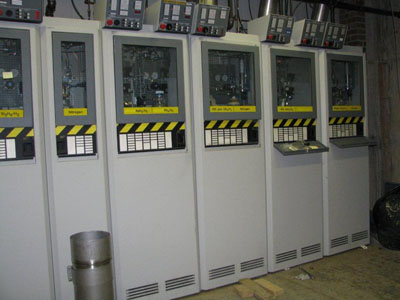
Figure 1: Continuously Mechanically Ventilated Enclosures
Safety Checklist for Work with Hazardous Gases in Laboratories
Understand the hazards of the gas. Is a hazardous gas required for the research or could a less hazardous gas be substituted?
Know if the laboratory is designed to allow for these materials to be handled safely
- Is it a large enough space for volumes needed? (See Table 1)
- Are there special ventilation requirements? (See Special Ventilation Requirements)
Minimize the volume of gas in use
- Use lecture bottles or small refillable bottles rather than a large cylinder
- For laboratory units where Gas Chromatographs or other analytical equipment may exceed MAQ, consider use of a hydrogen gas generator (See http://www.mathesongas.com/pdfs/products/Chrysalis-Standard-Economy-Hydrogen-Generator.pdf)
Be aware of laboratory surroundings
- Know the aggregate total of hazardous materials in the laboratory
- Understand the hazards present in surrounding laboratories and work areas (consider areas above and below the laboratory)
Evaluate the equipment used with hazardous materials
- Researchers are responsible for checking with manufacturers to determine if equipment may be used as planned in experiments
Ensure that piping for compressed and hazardous gases:
- Is compatible with materials in use (including fittings & connectors)
- Is properly installed and supported
- Uses backflow preventers, flash arresters, and automatic shutoff protection wherever possible to reduce risks of gas leaks, fire and explosions