Vacuum Line Protection
Vacuum systems (both centralized and stand alone pumps) are commonly used to help researchers filter reagents and dispose of waste among other uses. It is very important to protect your vacuum system from the biohazardous pathogens and toxins routinely used in research. Protecting the central vacuum keeps other labs, building staff, and the environment safe, and protecting portable vacuum pumps reduces the risk of contaminating the lab with dangerous aerosols.
The OSHA bloodborne pathogen standard states "Vacuum lines shall be protected with liquid disinfectant traps and high efficiency particulate air (HEPA) filters or filters of equivalent or superior efficiency which are checked routinely and maintained or replaced as necessary."
The images below are examples of safety equipment and accessories that meet University policy requirements for vacuum line protection. These items can be purchased from many distributors (Fisher Scientific, VWR, etc.) and catalog numbers are listed as a reference.
Protection Setup
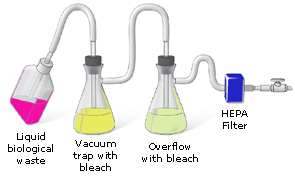
The first sidearm flask functions as the vacuum trap and the second acts as the overflow back-up. These two flasks contain enough household bleach so that the final concentration of waste is 10% bleach when full. An in-line HEPA filter is the last defense and prevents aerosols from entering the line. The flasks should be set in a plastic bucket or tray so that if they break the spill is easily contained. This image is adapted from the Biosafety in Microbiological and Biomedical Laboratories (BMBL) 5th Edition, Appendix A.
Nalgene Polypropylene Sterilizing Trays Fishersci cat# 13-359 Secondary Containment Trays
Sides should be high enough to contain liquids in case a flask breaks
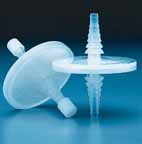
Millipore Millex Filter Units Fishersci cat# SLFG85010 and SLFG025LS
In-line HEPA Filters
HEPA filters remove 99.97% of .3mm particles and protect house vacuum lines from contamination