Arachnids
Depending on activity, location, and habitat, outdoor workers have the potential to encounter arachnids and should take the appropriate precautions to prevent injury. Arachnida is a class home to several orders containing spiders, scorpions, mites, ticks, and more. In Illinois, the arachnids of most concern include the brown recluse spider, the northern and southern black widow spider, the extremely rare venomous striped bark scorpion, the larvae of the Chigger mite, and ticks. For information about ticks, see Tick Hazards. Be sure to research arachnids you may encounter when working outside of Illinois.
If at any point you are concerned whether you have been bitten by a brown recluse spider, black widow spider, or striped bark scorpion, call the Poison Center Helpline at 1-800-222-1222 or use webPOISONCONTROL® to get help online.
Brown Recluse
(Loxosceles reclusa)
Sometimes referred to as the violin or fiddleback spider.
Identification: Typically, have a body length of ¼- to ¾-inch (≈6-19 mm), light brown, uniformly colored abdomen with fine hairs, eight uniformly colored legs without spines, and six equal-sized eyes arranged in three pairs. Adults are identified by a characteristic dark violin-shaped (or fiddle-shaped) marking on their back immediately behind the eyes that are not present in young spiders and appear during development.
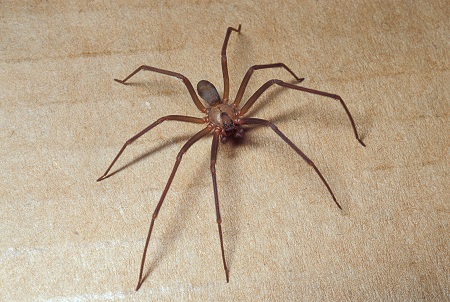
Brown Recluse: Credit: Missouri Department of Conservation.
Behavior: Typically active outdoors from March to October, but may be active year-round in warm indoor areas. They are nocturnal, reclusive, retreat when threatened, and rarely seen. During the day, they rest in loose, flat, sheet-like webs in undisturbed locations. Bites are uncommon but may occur when the spider is unintentionally trapped between an object and skin (i.e., picking up a box, putting on shoes).
Habitat: Found in secluded, dark, dry, sheltered areas. Outdoors under debris, woodpiles, rocks, and logs; however, indoor structures provide more favorable conditions. Buildings typically become infested when brown recluse hitchhike indoors on items, inhabiting basements, crawl spaces, wall voids, attics, closets, furniture, clothing, boxes, etc.
Distribution: Found throughout the southern and midwestern United States, inhabiting the southern two-thirds of Illinois.


IL Distribution. Credit: IDNR. U.S. Distribution. Credit: UC Riverside Spider Research.
Health Risks of Brown Recluse Bites
| Signs and Symptoms | Treatment |
|---|---|
|
|


Stages of a normal brown recluse bite. Credit: Pest Guide. Signs of Necrosis 3 days after the bite. Credit: Malaque C.M.S., et al.
Black Widow
(Latrodectus mactans and Latrodectus variolus)
Identification: Young black widows have spots and stripes of red, orange, or yellow on the upper surface of their abdomens and are gray to brown, becoming black as they mature. Adult males are typically 3-4 mm (≈ ⅛-5∕32-inch) long, shiny black with red or white markings on the abdomen. Adult females are typically 8-10 mm (~½-inch) long, shiny black with red or orange complete or broken hourglass-shaped markings on the underside of the abdomen.
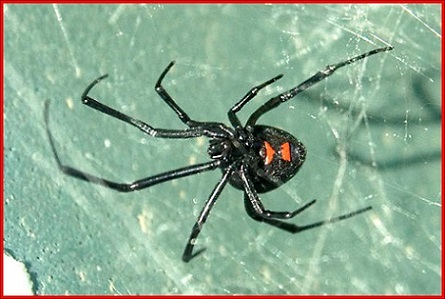

Female northern black widow (Latrodectus variolus), underside view (left) and posterior view (right). Credit: MSU.

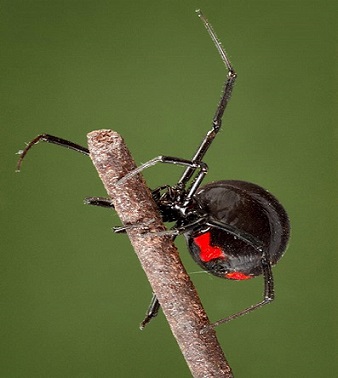
Female southern black widow (Latrodectus mactans), underside views. Credit: James Gathany, CDC.
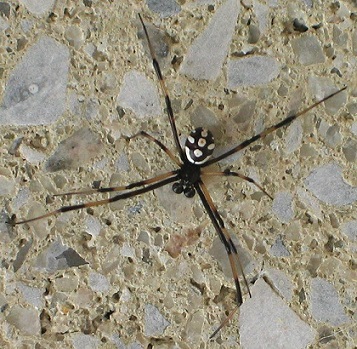
Male southern black widow. Credit: Lynette Elliott, BugGuide.net.
Behavior: They build irregular-shaped webs about one foot in diameter in dark, sheltered locations. Active at temperatures above 70 °F, nocturnal, reclusive, retreat when threatened, and bite if provoked. Bites are uncommon but may occur when a person encounters a web and the spider is unintentionally touched or trapped between and object and skin.
Habitat: Favor dry, dark, protected locations and warm areas in the winter. Found outdoors in yards, fields, woods, outdoor structures, hollow stumps, rodent burrows, and wood and rock piles. Indoors, they favor undisturbed, cluttered areas in basements and crawl spaces.
Distribution: Three species of black widows are widespread in the United States; two occur in Illinois. The northern black widow (Latrodectus variolus) inhabits the Northeast, South, and parts of the Midwest, including Illinois, and the southern black widow (Latrodectus mactans) inhabits the South and parts of the Midwest, including Illinois.
Health Risks of Black Widow Spider Bites
Black widow spider bites can be dangerous, but fatal bites are rare.
| Signs and Symptoms | Treatment |
|---|---|
|
|
Striped Bark Scorpion or Plains Scorpion
(Centruroides vittatus)
Identification: They have a flattened, elongated oval body, pincers, eight legs, and a long curling tail with a stinger. Adults are typically 2½-inches long, yellow-brown with a dark triangle on top of the head and two dark stripes along the back.

Striped bark scorpion. Credit: Missouri Department of Conservation.
Behavior: Active at night and reclusive, so rarely seen. They prefer to retreat from humans but will rear their tails when threatened and strike if touched, stepped on, or grabbed.
Habitat: Inhabit crevices in wood, rocky and open grassy areas. May be found in buildings and under piles of wood, brush, or debris.
Distribution: The most common scorpion in the United States; found in Arkansas, Colorado, Illinois, Kansas, Louisiana, Mississippi, Missouri, Nebraska, New Mexico, Oklahoma, and Tennessee. Found in Monroe County, Illinois.
Health Risks of Striped Bark Scorpion Stings
The striped bark scorpion is venomous; however, the venom has low toxicity.
| Signs and Symptoms | Treatment |
|---|---|
|
|
Venomous Spider Bite and Scorpion Sting Prevention
If working in a known infested habitat,
Wear a long-sleeve shirt, pants, closed-tow shoes, hat, and leather gloves when handling stored items (e.g., lumber, rocks, boxes, shoes).
Inspect and shake out items stored in an infested structure before use and avoid clutter, use glue traps to monitor infestations, and utilize pest control services if necessary.
Carry an epinephrine autoinjector (EpiPen) if you have a history of severe allergic reactions to insect bites or stings.
Chigger Mite Larvae
(Trombiculidae, Eutrombicula spp.)
Also known as red bugs and harvest mites, only the larval stage is parasitic, feeding on the skin cells of rodents, ground-dwelling birds, and mammals, including humans.
Identification: Larval chiggers are red, have six legs, and are extremely small, less than 1∕150-inch (0.17 mm) in diameter. Adults are also red, have eight legs, and are about 1∕60-inch (0.42 mm) in diameter.


Chigger. Credit: Susan Ellis, Bugwood.org.
Behavior: Most active in the afternoon in summer and fall when the ground temperature is 77-86 °F (25-30 °C) and become inactive under 60 °F (15.6 °C). The larvae wait on plants for a host to pass by to climb on. Once a host is found, they typically attach near a skin pore or hair follicle of thin, tender, or wrinkled skin (ankles, behind the knees, armpits) or where clothing is tight and restrictive (near the waistline). When they attach, they inject saliva containing a digestive enzyme into the skin that breaks down the skin cells into a liquid they eat. They do not burrow into the skin or feed on blood. They are easily disturbed and removed during scratching, but they will feed up to three days before falling off if left undisturbed.
Habitat: Found in overgrown brushy, grassy, or weedy areas, thickets, forests, and shady, humid areas along streams and lakes, as well as yards, parks, campsites, and golf courses.
Health Risks of Chigger Bites

Chigger bites. Credit: woodleywonderworks, Flickr.
| Signs and Symptoms | Treatment |
|---|---|
|
|
Chigger Bite Prevention
Wear a long-sleeve shirt and pants tucked into socks or boots. Tightly woven fabric is preferable.
See Repellent Options and Application Guidance to learn about repellents and how to apply them. Apply only the label-recommended amount.
- Use EPA-registered insect repellents on skin.
- Treat clothing with products containing 0.5% permethrin and apply insect repellents to the outward-facing surface of clothing for additional protection.
- Warning: Wet permethrin is toxic to cats, fish, aquatic invertebrates, bees, and other beneficial insects. Take precautions when applying it to clothing, and never apply to skin.
Walk in the center of trails, avoid walking in humid fields, brush, and overgrowth, avoid brushing against vegetation, and don’t sit down in tall grass.
Vigorously rub your skin to dislodge chiggers if you may have entered an infested area without proper protective clothing.
Shower immediately after coming indoors and wash exposed clothing and gear with hot water.
Resources
Advocate Children’s Hospital – Chigger Bites
Canadian Geographic – Black Widow Spider
CDC-NIOSH – Venomous Spiders: Venomous Spiders
CDC-NIOSH – Insects and Scorpions: Insects and Scorpions
Everson, G. W. (2014). Scorpions. Encyclopedia of Toxicology, 4, 223–225
Fairview Health Services – Chigger Bite
IDNR – Brown Recluse
IDNR – Illinois Spiders
IDNR – Scorpions in Illinois?
IDNR – Striped Bark Scorpion
IDNR – Wild About Illinois Spiders!
IDPH – Mites Affecting Humans
IDPH – Spiders
Kansas State University: Brown Recluse
Mayo Clinic – Spider bites
Mayo Clinic – Spider bites: First aid
Michigan State University – Northern Black Widow Spider
Missouri Department of Conservation – Field Guide
National Capital Poison Center – Black Widow Spider Bites
National Capital Poison Center – Brown Recluse Spider Bites
North Carolina State Extension: Spiders in and around homes
Northern Illinois University – Illinois’ Venomous Creatures Strike Back
OSHA Fact Sheet – Brown Recluse Spider
OSHA Fact Sheet – Black Widow Spider
PestGuide – The Bite Stages of a Brown Recluse Spider – An Infographic!
PestWorld – Black Widow Spiders
Shelley, R. M.; Sissom, W. D. (1995). “Distributions of the scorpions Centruroides vittatus (Say) and Centruroides hentzi(Banks) in the United States and Mexico (Scorpiones, Buthidae)”. J. Arachnol. 23: 100-110.
UC-IPM – Brown Recluse Spider
University of Kentucky – Brown Recluse Spider
University of Kentucky – Chiggers
University of Maryland Extension – Chiggers