Snakes
Depending on location and habitat, outdoor workers have the potential to encounter venomous snakes and should take the appropriate precautions to prevent a bite. According to the CDC, an estimated 7,000-8,000 people per year receive venomous bites in the U.S., and about 5 of those people die. Snake venom may cause tissue or nerve damage, but a snake bite is usually not fatal to humans if proper medical treatment is received. Disability and permanent injury, such as the loss of part or all of a finger or its function, are much more common.
Health Risks of a Snakebite
Nonvenomous snake bites can include pain, swelling, redness, and scratches at the site.
Venomous snake bite signs and symptoms may include:
|
|
Sometimes, a venomous snake can bite without injecting venom. The result of these “dry bites” is irritation at the site.


Treatment: What TO DO if a Snake Bites You or Someone Else
Immediately move away from the snake. Note the color and shape of the snake or take a photograph from a safe distance if possible. Identification of the snake can help with treatment of the bite.
Remain calm, panic by the person bitten or by someone assisting can elevate the bitten person’s heart rate. An elevated heart rate will circulate the venom through the blood stream faster.
Remain calm; panic can elevate the heart rate, increasing venom circulation in the blood.
If you can confidently identify the snake as non-venomous:
- Clean the wound thoroughly with soap and water or antiseptic wipes.
- Seek medical attention for signs of an allergic reaction or signs of infection.
If you suspect the snake may be venomous:
- Seek medical attention as soon as possible even if you suspect it is a dry bite (no venom delivered), dial 911, or have someone drive you to the nearest hospital. Call the Illinois Poison Center at 800-222-1222; they will gather information and prepare the hospital before your arrival.
- Antivenin is the treatment for serious venomous snake bites. The sooner antivenin is administered, the sooner irreversible damage can be stopped.
- Caution: Driving oneself to the hospital is not advised; people with snakebites can become dizzy or pass out.
- Directly after or en route for medical treatment, apply first aid.
- If possible, position yourself so that the bite is at or below the level of your heart.
- Remove jewelry and tight clothing in preparation for swelling.
- Clean the wound with soap and water. Cover it with a clean, dry dressing.
- Immobilize the affected limb unless it is necessary to hike towards help.
- If possible, mark the leading edge of tenderness/swelling on the skin and write the time alongside it.
- Seek medical attention as soon as possible even if you suspect it is a dry bite (no venom delivered), dial 911, or have someone drive you to the nearest hospital. Call the Illinois Poison Center at 800-222-1222; they will gather information and prepare the hospital before your arrival.
If you have never received a tetanus vaccine or have not had a booster in the last five years, seek evaluation by a medical professional.
Treatment: What NOT TO DO if a Snake bites You or Someone Else
Do not pick up the snake or try to trap it.
Do not wait for symptoms to appear if bitten; seek immediate medical attention.
Do not apply a tourniquet.
Do not slash the wound with a knife or cut it in any way.
Do not try to suck out the venom.
Do not apply ice or immerse the wound in water.
Do not take pain relievers (aspirin, ibuprofen, naproxen, etc.).
Do not drink caffeine or alcohol, which could speed up your body’s absorption of the venom.
Identification
Nonvenomous snakes typically have rounded heads, round pupils, and no fangs. Illinois venomous snakes are pit vipers. They can be identified by their elliptical pupils, triangular-shaped head, fangs, and a large opening, or “pit,” on each side of the head between the mouth and nostril. Except for the timber rattlesnake, the tip of the tail is bright yellow in all juvenile Illinois venomous snakes. Be sure to research venomous snake species you may encounter when working outside of Illinois.
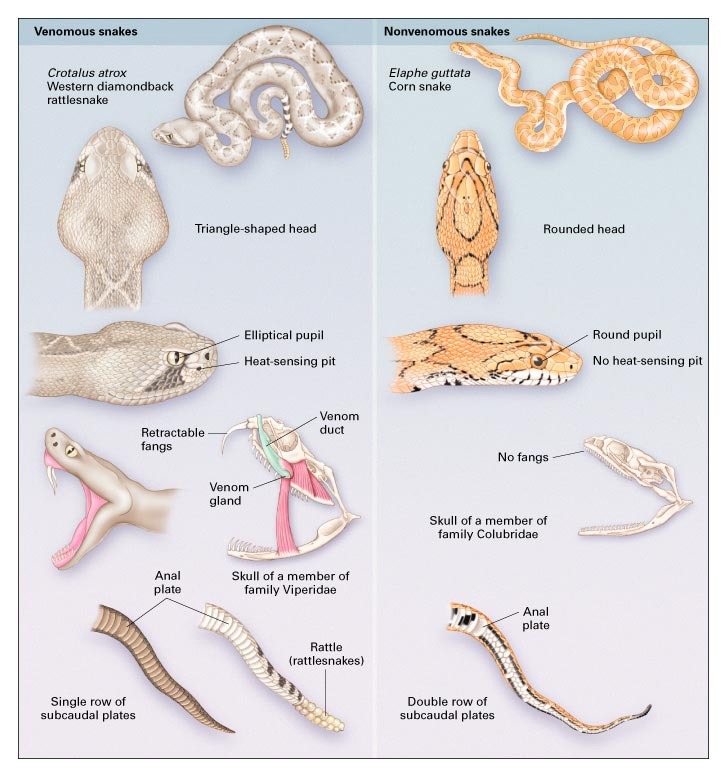
Credit: Gold BS, Dart RC, Barish RA. Bites of Venomous Snakes. New England Journal of Medicine 2002;347(5):347-56
Forty snake species inhabit Illinois, dwelling in forests, grasslands, marshes, swamps, ponds, lakes, streams, rivers, and sloughs.
Four species of Illinois snakes are venomous:
Eastern Copperhead (Agkistrodon contortrix)
Northern Cottonmouth (Agkistrodon piscivorus)
Timber Rattlesnake (Crotalus horridus) – Threatened
Eastern Massasauga (Sistrurus catenatus) – Endangered
Snake Bite Prevention
Snakes are not aggressive and tend only to bite when stepped on, picked up, or cornered. Take the following steps to reduce the chances of a bite:
Illinois snakes are active in spring, summer, and fall and hibernate during the winter. Most snake bites in the U.S. occur during May-October.
They are generally active during the day, but they can become nocturnal when summer temperatures rise.
Identify if you will be working in known venomous snake habitat (for IL species, see distribution maps on pages 4-5) and determine which regional or local hospitals carry antivenin, uisng CroFab®’s Locator4a.
- When working in potential venomous snake habitat, use active situational awareness.
- Constantly scan your surroundings.
- Look down to where your next step will be while you walk and scan bushes and other understory vegetation.
- Try to remain on paths as much as possible.
- Avoid tall grass and piles of leaves.
- Avoid climbing on rocks or piles of wood. Keep hands and feet out of areas you can’t see.
- Do not step over logs or large rocks unless you can see what is on the other side. Instead, step up onto the log or rock, look down to the other side, then step down.
- When lifting objects or equipment from the ground, always lift the far side of the object up and towards you. If a snake is under the cover object or equipment, it serves as a barrier between you and the snake.
- Be aware snakes may be swimming in the water.
- When working in potential venomous snake habitat, use active situational awareness.
Wear appropriate protective clothing in known venomous snake habitat. These articles of clothing may not prevent a bite but can decrease the chances of penetration.
For terrestrial situations, wear leather boots, long pants or denim jeans, and snake gaiters or chaps.
In semi-aquatic situations, wear knee or hip boots.
For fully aquatic situations, wear waders.
- Wear leather gloves when handling brush and debris.
 |
| Snake Gaiters |
 |
| Snake Chaps |
Stop, remain calm, slowly back away, and do not touch it. Do not harass it or try to capture or kill it. Most bites occur when someone is intentionally interacting with a snake.
Snakes will usually try to escape to the nearest cover; avoid standing between them and bushes or other cover.
If cornered, a snake may act defensively or try to strike. Snakes can strike up to nearly half their body length without coiling. A coiled snake can strike up to two-thirds of its body length.
When startled, some snakes will flatten their heads and puff up to make themselves look more intimidating. They may also release a smelly musk.
Snakes may hiss or vibrate their tails using a rattle or by vibrating it against the ground as defensive mechanisms to warn away potential predators, especially if they feel cornered. Be aware that they may not have time to sound before striking and rattle strings may be broken on some rattlesnakes.
- What it sounds like:
- Snake hiss
Credit: freesoundeffects.com - Rattlesnake vibrating its tail rattle
Credit: Public Domain - Non-Rattlesnake vibrating its tail
Credit: Extracted audio from California Herps Video
- Snake hiss
- What it sounds like:
CroFab® Snakebite911 App
Download the CroFab® Snakebite9114b app available for Android and iPhone devices. This app provides education about North American pit vipers, can help track the progression of a bite, and find a hospital nearby.

Venomous Snakes in Illinois
Eastern Copperhead (Agkistrodon contortrix)
Identification: Pit viper. Distinguished by a copper-red head; red-brown or yellow-brown body; hour-glass markings across the back when viewed from above. Adults average 24-36 inches (≈60-90 cm) in length.


Behavior: Active during the day (diurnal) in spring and fall, become nocturnal in the hottest summer months. When disturbed, will flee. If trapped, rapidly vibrate tail, making noise against whatever the tail hits. Not usually aggressive, but often freeze when frightened and l strikes in defense when threatened. May be found in groups, particularly in fall when moving to overwintering dens.
Habitat: Prefers upland forests or river bluffs with limestone or sandstone outcroppings.
Distribution: Found in the southern one-third of Illinois (south of Route 16) and in the lower Illinois River valley.
Northern Cottonmouth (Agkistrodon piscivorus)
Identification: Pit viper. May be plain black or brown above with little evidence of a pattern. Some have dim crossbands across the back. The tip of a young cottonmouth’s tail is yellow. Adults average 30-42 inches (≈75-105 cm) in length.


Behavior: Semiaquatic and mainly nocturnal. When disturbed, will either remain in place and vibrate its tail or slowly crawl/swim away. May tilt its head up and gape, showing the white interior of its mouth, hence the name “cottonmouth.” Overwinters in dens in rock crevices with other species of snakes.
Habitat: Inhabits swamps and wet bottomlands. Frequently found in or around water.
Distribution: Found in swamps and wet bottomlands of extreme southern Illinois (south of Route 13).
Timber Rattlesnake (Crotalus horridus) – Threatened
Identification: Pit viper. Rattle present at the tip of the tail. Has keeled scales (ridged). The body is gray, yellow, or green-white with a series of dark bands along the back. A rust-colored stripe is present in the middle of the back, and a dark bar may be found between the eye and jaw. Adults average 36-60 inches (≈90-150 cm) in length.


Behavior: Active during the day (diurnal) until temperatures become too high in summer and then becomes nocturnal. Remains hidden and camouflaged. When disturbed, will try to escape or coil and rattle the tip of the tail producing a buzzing noise. Hibernates in dens in rock crevices with other snake species.
Habitat: Inhabits prairie wetlands and river floodplains. Prefers heavy timber with rock outcrops and bluffs.
Distribution: Found in southern one-fourth of Illinois (south of Interstate 64), in the lower Illinois River valley, and in the Mississippi River valley.
Eastern Massasauga (Sistrurus catenatus) – Endangered
Identification: Pit viper. Rattle present at the tip of the tail. Scales are keeled (ridged). A row of dark blotches is present down the back, and there are three rows of dark spots on the sides. The body is gray. Adults average 18-30 inches (≈45-75 cm) in length.


Behavior: Active in the day (diurnal), except in the hottest summer months it becomes nocturnal. May shelter in crayfish burrows, rodent burrows, or other underground cavities. Basks on grass, near crayfish burrows, downed woody vegetation, or other open locations. If disturbed, may rattle but most likely will remain motionless.
Habitat: Primarily inhabits wet prairies and grasslands with perched water tables. Sometimes associated with grasslands along waterways.
Distribution: Historical distribution map shows scattered locations across Illinois, contemporarily only occurs in Clinton County.
Resources
CroFab® Crotalidae Polyvalent Immune Fab (Ovine) antivenin:
The Asclepius Snakebite Foundation® - How to Survive a Snakebite in the Wilderness